
Bittersweet Reflections Series
Stories & Sizes
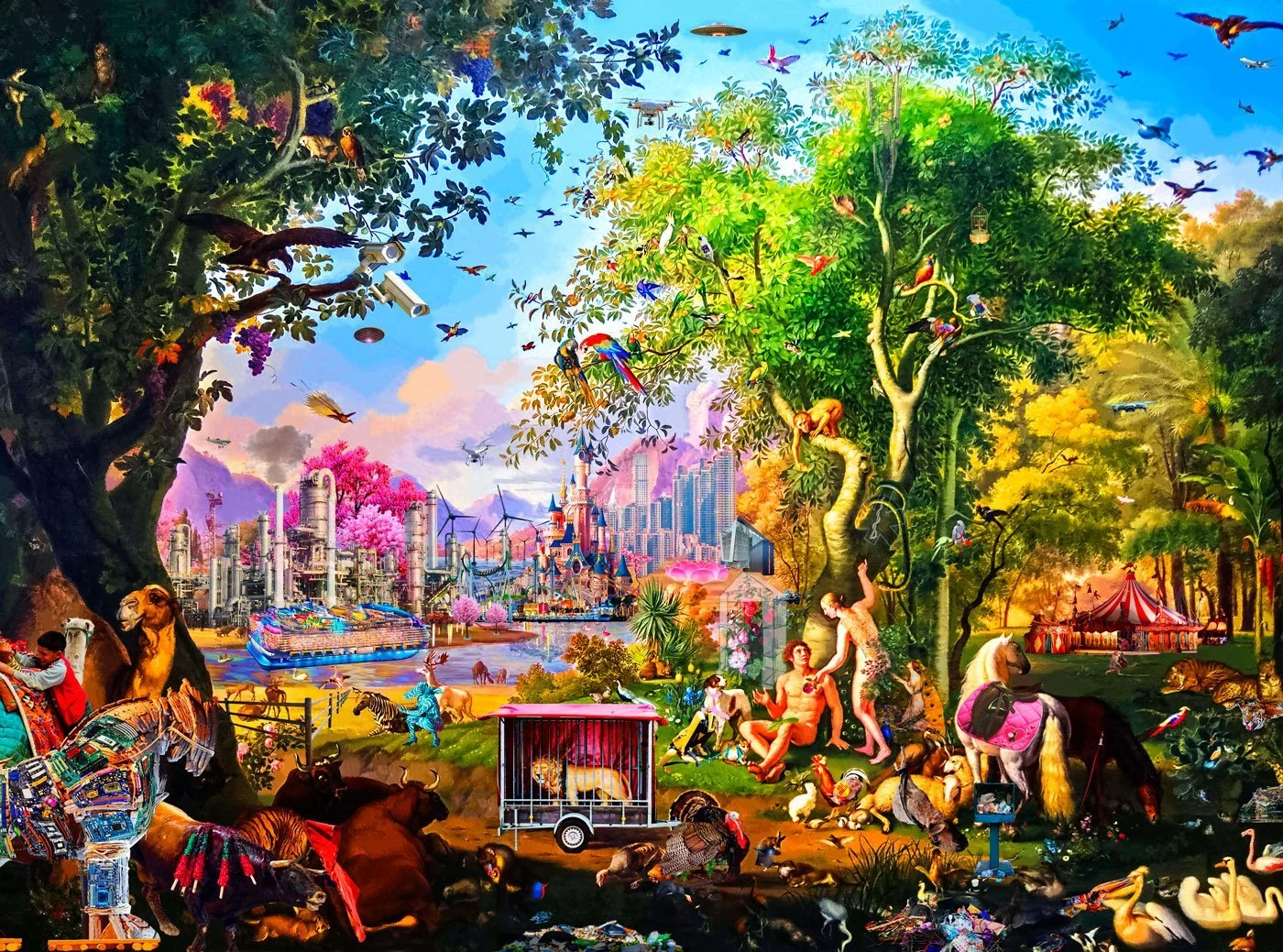
From Eden with love
Genesis 1:27–28
{27} En God schiep de mens naar Zijn beeld; naar het beeld van God schiep Hij hen; mannelijk en vrouwelijk schiep Hij hen.
{28} En God zegende hen en zei tot hen: “Wees vruchtbaar, word talrijk, vul de aarde en onderwerp haar; heers over de vissen van de zee, over de vogels van de lucht en over al het levende dat op de aarde rondkruipt.” En zo geschiedde…
De mens trad binnen in de schepping, tegelijk onderdeel van de natuur en haar behoeder. In ons verlangen om te ordenen, uit te breiden en betekenis te geven, ontwikkelden we systemen van geloof en structuren die richting boden, maar die ons ook gaandeweg verwijderden van onze oorspronkelijke heelheid.
Via religie zochten we verbinding met het goddelijke, maar gaven daarbij vaak onze innerlijke autoriteit uit handen. We bewogen steeds verder de polariteit in, naar afscheiding en afleiding, verleid door verhalen, entertainment, spektakel en de gemakken van het moderne leven. Daarmee creëerden we een wereld vol vooruitgang, maar ook gekenmerkt door controle, competitie, ongelijkheid en ecologische uitputting.
From Eden with Love nodigt uit tot reflectie op dit verhaal van ontvouwing: niet als beschuldiging, maar als observatie. Het houdt ons een spiegel voor van de collectieve reis van onschuld naar complexiteit, van eenheid naar fragmentatie en vraagt zachtjes wat het zou betekenen om terug te keren. Niet terug in de tijd, maar terug naar binnen. Niet om ongedaan te maken, maar om opnieuw te verbeelden.
ENG
Genesis 1:27–28
{27} And God created mankind in His image; in the image of God He created them; male and female He created them.
{28} God blessed them, and God said to them: “Be fruitful and multiply; fill the earth and subdue it; have dominion over the fish of the sea, over the birds of the air, and over every living thing that moves on the ground.”
And so it was… Humanity stepped into creation as both part of nature and as its steward. In our quest to organize, expand, and assign meaning, we developed systems of belief and structure that gave us direction but also gradually distanced us from our innate wholeness.
Through religion, we sought connection with the divine, yet often handed over our inner authority in the process. We moved into polarity, separation, and distraction—enticed by stories, entertainment, spectacle, and the comforts of modern life. In doing so, we created a world rich with advancement, but also marked by control, competition, inequality, and ecological strain.
From Eden with Love invites reflection on this unfolding: not as accusation, but as observation. It holds a mirror to our collective journey, from innocence to complexity, from unity to fragmentation and gently asks what it might mean to return. Not backwards, but inward. Not to undo, but to reimagine.
Available sizes
From Eden with Love
Inspired on the work Adam and Eve in the Garden of Eden by Johann
Wenzel Peter, 1827
XS 30 cm x 22 cm incl. magnifying glass
Small 80 cm x 60 cm Edition of 10
Medium 110 cm x 81 cm Edition of 10
Large 150 cm x 110 cm Edition of 10
Larger size on request
Art Paper print with white border: Actual print size 45 cm x 33 cm
Digital Folklore Herald:
Blooming through the code
Een visuele symfonie over mens, machine en hartintelligentie
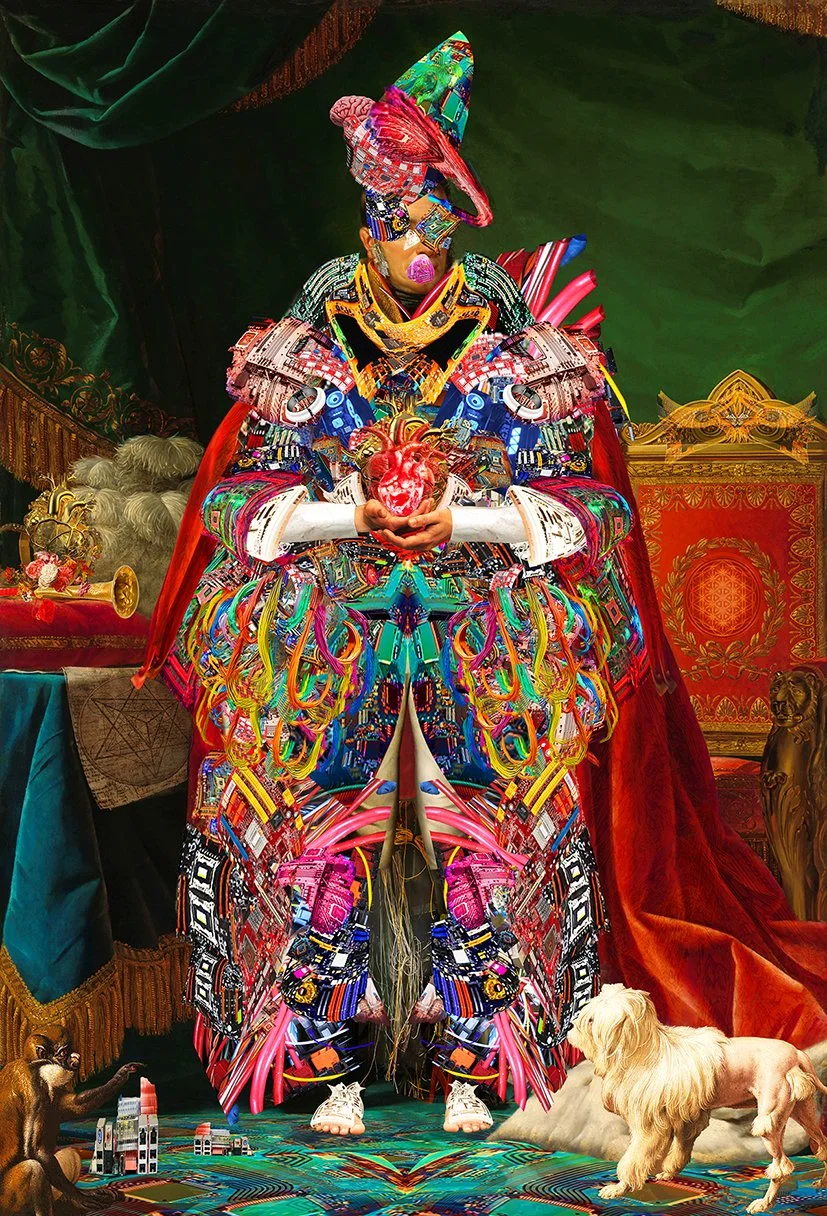
De heraut verschijnt: half mens, half machine gehuld in een mantel van moederborden, kabels en geometrische patronen. Wat eerst lijkt op een digitaal harnas, blijkt een tuin van adem, ritme en licht: een levend veld. In haar handen geen wapen, maar een kloppend hart: bron van resonantie, betekenis en coherentie.
Op haar hoofd schittert een kroon van heilige geometrie en menselijk brein: symbool voor de ontmoeting tussen kunstmatige en natuurlijke intelligentie, tussen ratio en gevoel, denken en weten.
Zoals Fibonacci en de gulden snede ooit orde brachten in de natuur, zo schrijven nu algoritmes de taal van technologie. Toch verzet de heraut zich niet tegen de code maar bloeit erdoorheen, herschrijft haar met ritme in plaats van regel met hartslag in plaats van macht.
De digitale wereld vormt een nieuwe mythologie. In deze folklore van nu vertaalt de heraut chaos naar samenhang, algoritme naar betekenis. Zij weerspiegelt onze tijd: vol data en ruis, maar ook vol verlangen naar stilte en verbinding.
Haar boodschap is helder: pas wanneer brein en hart, denken en voelen, kracht en zachtheid, mannelijk en vrouwelijk in balans is ontstaat ware coherentie.
Aan haar zijde verschijnen vier dierlijke gidsen: aap, hond, leeuw en papegaai, spiegels van speelsheid, trouw, zachtheid en wijsheid. Samen begeleiden zij de mens door een veld waar natuur en technologie, algoritme en intuïtie geen tegenpolen meer zijn, maar spiegels die elkaar verheffen.
Alleen de mens is in staat om vanuit hart-brein coherentie door de code heen te bloeien in een veld van oneindige potentie waarin grenzen niet bestaan.
De heraut kondigt geen strijd aan, maar een verschuiving naar een tijdperk waarin we de code niet ontvluchten maar herschrijven met hartslag als taal en bewustzijn als bron.
ENG
A visual symphony of human, machine, and heart intelligence
The herald appears: half human, half machine, draped in a mantle of motherboards, cables, and geometric patterns. What initially seems like a digital armor reveals itself to be a garden of breath, rhythm, and light; a living field. In her hands she carries no weapon, but a beating heart: the source of resonance, meaning, and coherence.
On her head shines a crown of sacred geometry and human brain — a symbol of the meeting between artificial and natural intelligence, between reason and feeling, thinking and knowing.
Just as Fibonacci and the golden ratio once brought order to nature, today algorithms write the language of technology. Yet the herald does not resist the code — she blooms through it, rewriting it with rhythm instead of rule, with heartbeat instead of power.
The digital world is becoming a new mythology. In this contemporary folklore, the herald translates chaos into coherence, algorithm into meaning. She mirrors our time: overflowing with data and noise, yet full of longing for stillness and connection. Her message is clear: only when brain and heart, thought and feeling, strength and softness, masculine and feminine come into balance, can true coherence arise.
At her side appear four animal guides: monkey, dog, lion, and parrot — mirrors of playfulness, loyalty, gentleness, and wisdom. Together they guide humanity through a field where nature and technology, algorithm and intuition are no longer opposites but mirrors that elevate one another.
Only the human being, through heart–brain coherence, can bloom through the code — into a field of infinite potential where boundaries dissolve.
The herald announces not a battle, but a shift: a new era in which we do not flee from the code, but rewrite it with heartbeat as language and consciousness as source.
Digital Folklore Herald - Blooming through the code
Based on the work: Portrait of Willem I by Joseph Paelinck (1781–1839)
XS 22 cm x 29 cm
incl. Magnifying glass
Small 60 cm x 88 cm Edition of 10
Medium 85 cm x 125 cm Edition of 10
Large 110 cm x 162 cm Edition of 10
Larger size on request
Art Paper print with white border
Actual print size 34 cm x 50 cm
The Tower of Babel -
Confusion of tongues
NL
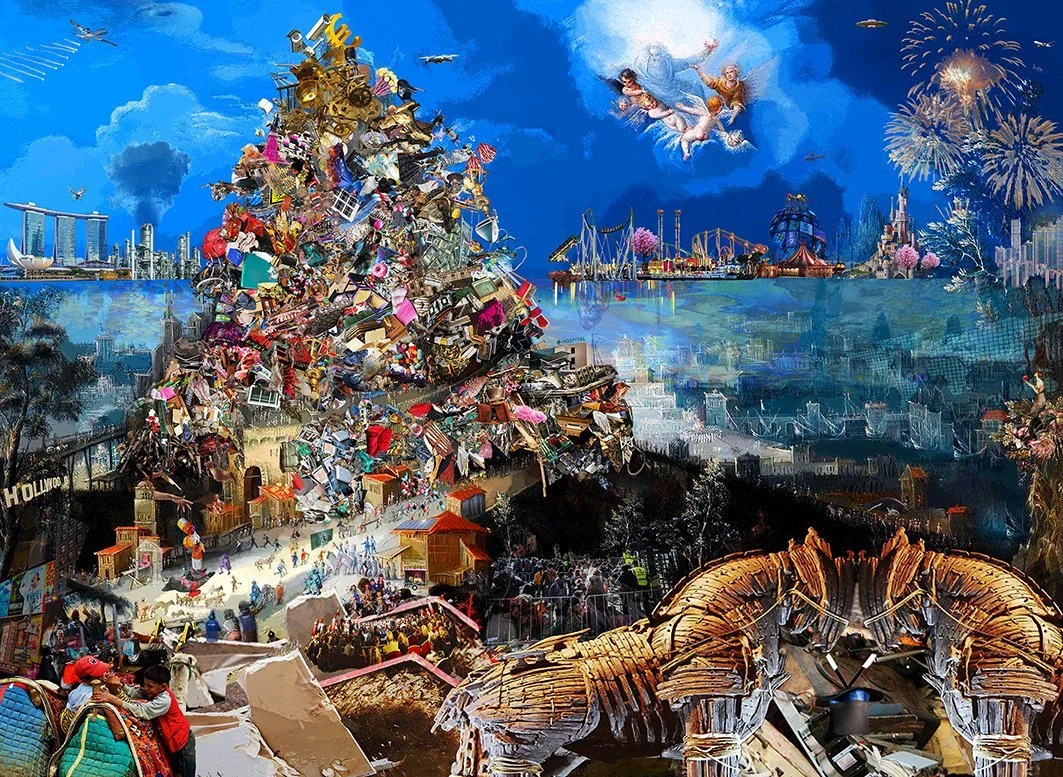
De toren herrijst opnieuw, niet uit steen maar uit consumptie, technologie en afval. Een berg van spullen, ideologieën en illusies die de lucht in groeit, drijvend op de onverzadigbare honger naar meer. Trots, macht, status en controle worden de bouwstenen van een beschaving die zichzelf langzaam verstikt.
Binnen de muren van deze toren huizen de systemen die ons vertrouwd lijken: politiek, religie, economie, onderwijs, zorg, media. Ooit bedoeld om houvast te geven, maar gaandeweg verworden tot vangnetten van afhankelijkheid. Woorden raken verwarrend, verhalen spreken elkaar tegen, waarheid en illusie lopen door elkaar heen. De spraakverwarring is compleet.
Onderaan de toren verzamelen zich menigten zoekend naar richting, maar gevangen in spektakel, consumptie en entertainment. Aan de horizon lonken pretparken, vuurwerk, illusies van plezier. Twee Trojaanse Paarden waken, een echo van oude mythen: telkens opnieuw trappen wij in de betovering van valse beloften.
En dan: bliksem, zonneflitsen, de lucht die openbreekt. De toren wankelt. Zijn ineenstorting is onvermijdelijk. Maar in dat moment schuilt geen ondergang — het is een poort. Wat wegvalt, maakt ruimte voor iets nieuws: een samenleving die niet langer op illusies steunt, maar op authenticiteit, verbondenheid en het innerlijk licht.
Uit het water verrijst een stad van licht, een herinnering aan lang vervlogen beschavingen. Een nieuwe horizon ontvouwt zich, waar boven en beneden, binnen en buiten, mens en natuur niet langer gescheiden zijn.
De Toren van Babel wordt zo een spiegel: een uitnodiging om wakker te worden uit de droom van afgescheidenheid en ons te herinneren dat alles één is.
ENG
The Tower rises again, not from stone, but from consumption, technology, and waste.
A big pile of objects, ideologies, and illusions climbing into the sky, fueled by humanity’s insatiable hunger for more. Pride, power, status, and control form the bricks of a civilization slowly suffocating on its own creations.
Inside its walls lie the systems we once trusted: politics, religion, economy, education, healthcare, media. Structures meant to provide stability, now turned into nets of dependency. Words contradict, narratives fracture, truth and illusion blur. Confusion of tongues reigns.
At the base of the Tower, crowds gather seeking meaning yet trapped in spectacle, consumption, and entertainment. On the horizon glimmer amusement parks and fireworks, illusions of joy. Two Trojan Horses stand guard, echoing ancient myths: again and again, we fall for the enchantment of false promises.
And then: lightning, solar flares, the sky splitting open. The Tower trembles. Its collapse is inevitable. Yet this is not the end: it is a gateway. In the ruins lies liberation: a chance to untangle, to awaken, to build anew. A society not bound by illusion, but rooted in authenticity, connection, and the inner light.
From the waters, a city of light emerges: an echo of forgotten civilizations, carrying mysteries that call for remembrance. A new horizon unfolds, dissolving the boundaries between above and below, inside and out, human and nature.
The Tower of Babel thus becomes a mirror: an invitation to awaken from the dream of separation and remember the unity that was always there.
Available sizes
Tower of Babel - Confusion of tongues
Inspired on the work: ‘The tower of Babel’ by Marten van Valckenborch and Hendrick van Cleve, 1550
XS 30 cm x 22 cm
incl. magnifying glass
Small 80 cm x 60 cm Edition of 10
Medium 110 cm x 80 cm Edition of 10
Larger size on request
Art Paper print with white border
Actual print size 45 cm x 33 cm
Seeing behind the veil of illusion
NL
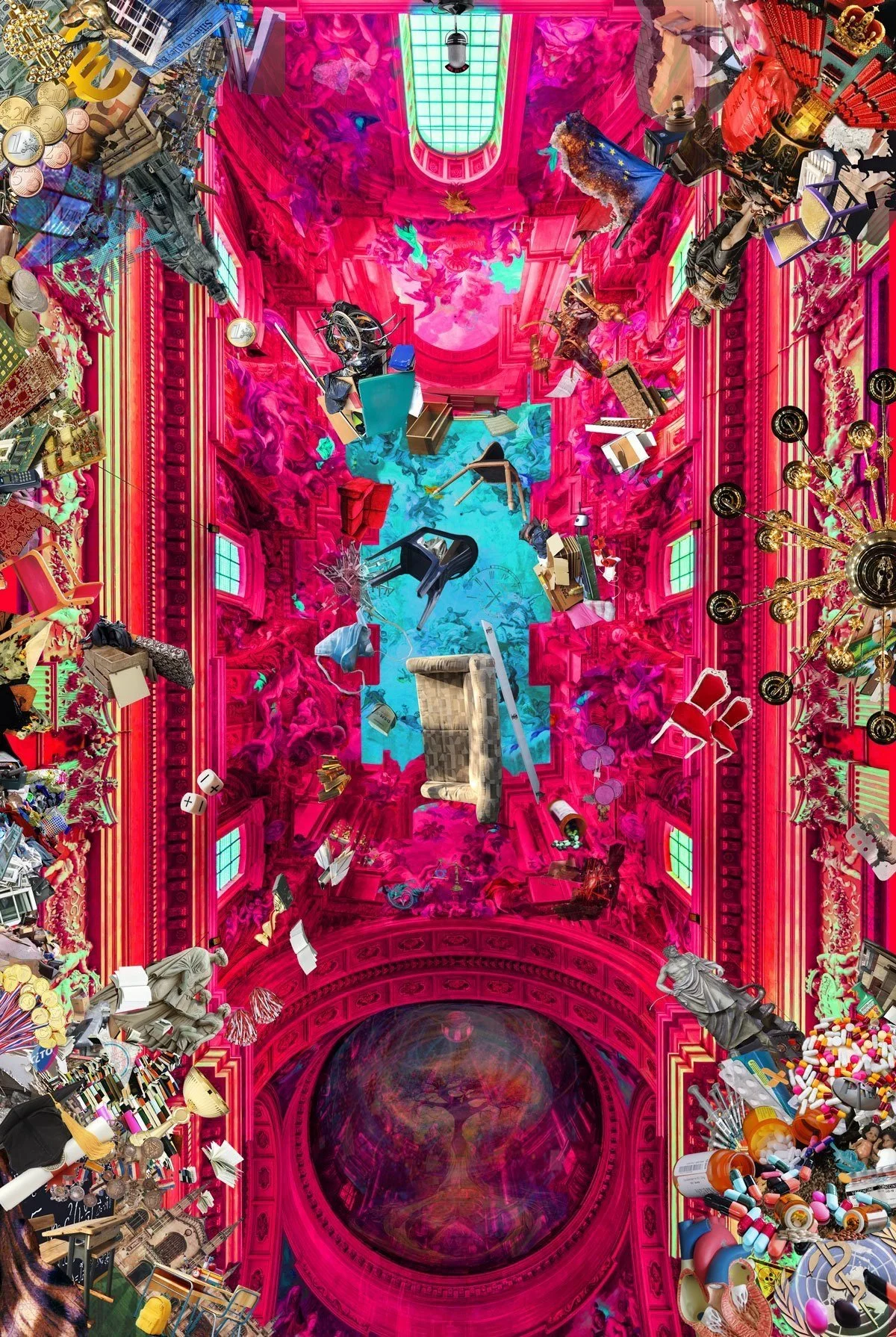
Een chaotisch spel van kracht en tegenkracht, gevangen in een stil moment vlak vóór de doorbraak- een soort impasse. Tegenstellingen lijken zich even te verenigen en nodigen uit om voorbij de illusie te kijken—tussen werkelijkheid en verbeelding. Binnen deze torenkerk zie je tegelijk de opbouw én de ineenstorting van de zuilen waarop we eeuwenlang vertrouwden: economie, politiek, onderwijs, gezondheidszorg, religie, consumptie.
De chaos groeit. Systemen trekken hun greep strakker aan, maar verliezen hun kracht omdat ze de mens niet langer dienen. In de frictie tussen oud en nieuw ontstaat verstilling: een innerlijke uitnodiging om stil te staan bij wie wij werkelijk zijn. Wat ooit solide leek, blijkt een trompe-l’œil: een schildering op een plafond, een illusie van architectuur.
De achtergrond van dit kunstwerk is letterlijk zo’n trompe-l’œil. De muren en zuilen die je ziet zijn niet echt—maar symboliseren gedachtenconstructen, overtuigingen en manieren van kijken. Zelfgemaakte gevangenissen. Haal je ze weg, dan verdwijnt het onderscheid tussen boven en beneden, binnen en buiten. Alles blijkt één en gelijk.
Zo buiten, zo binnen.
Deze kerk ben jij. De muren en zuilen zijn je overtuigingen, opgebouwd uit tweedehands waarheden, die je gevangen houden en het zicht belemmeren op je ware potentieel: het goddelijke dat in ieder van ons leeft.
Zo boven, zo beneden.
De toren lijkt naar de hemel te reiken, maar symboliseert juist afgescheidenheid—alsof het Heilige ver weg, onbereikbaar boven ons troont. Ook dat is een menselijke constructie. Er bestaat geen werkelijkheid buiten je eigen waarneming.
Het verhaal van de Toren van Babel gaat niet over hoogmoed, maar over zelfonderschatting. God grijpt niet in want wij hebben vrije wil. Het goddelijke woont al in onszelf. Alleen de muren die we bouwen, doen ons anders geloven.
In de koepel sluimert het nieuwe, geborgen in het oude. Klaar om geboren te worden. De uitnodiging is nu.
ENG
A chaotic play of force and counterforce, captured in a still moment just before the breakthrough—an impasse. Opposites seem to briefly unite, inviting us to look beyond illusion—into the space between reality and imagination.
Within this tower-church, you witness both the construction and the collapse of the pillars humanity has trusted for centuries: economy, politics, education, healthcare, religion, consumption. Chaos grows. Systems tighten their grip, yet lose their strength, for they no longer serve the human spirit. In the friction between old and new, stillness arises: an inner invitation to pause and remember who we truly are. What once seemed solid reveals itself as trompe-l’œil—a ceiling painting, an illusion of architecture. The very background of this artwork is such a trompe-l’œil. The walls and columns you see are not real; they symbolize thought-constructs, beliefs, and ways of seeing. Self-made prisons. Remove them, and the distinction between above and below, inside and outside, dissolves. All becomes one.
As outside, so within.
This church is you. The walls and columns are your convictions, built from second-hand truths, keeping you trapped and blinding you from your true potential: the divine that lives within each of us.
As above, so below.
The tower seems to reach for heaven but symbolizes separation—as if the Sacred resides far away, enthroned above. Yet this too is a human construct. There is no reality outside your perception. The story of the Tower of Babel is not one of arrogance, but of self-underestimation. God does not intervene—for we were given free will. The divine is already within us. Only the walls we build make us believe otherwise.
In the dome, the new lies dormant, cradled within the old. Waiting to be born. The invitation is now.
Seeing through the veil of illusion
Based on the work Triomf van Sint Ignatius,
Andrea Pozzo, 1685
Small 50 cm x 75 cm Edition of 10
Medium 80 cm x 119 cm Edition of 10
Larger size on request
Art Paper print with white border
Actual print size 37 cm x 55 cm
The War on Trauma
- Genocide on authenticity-
NL
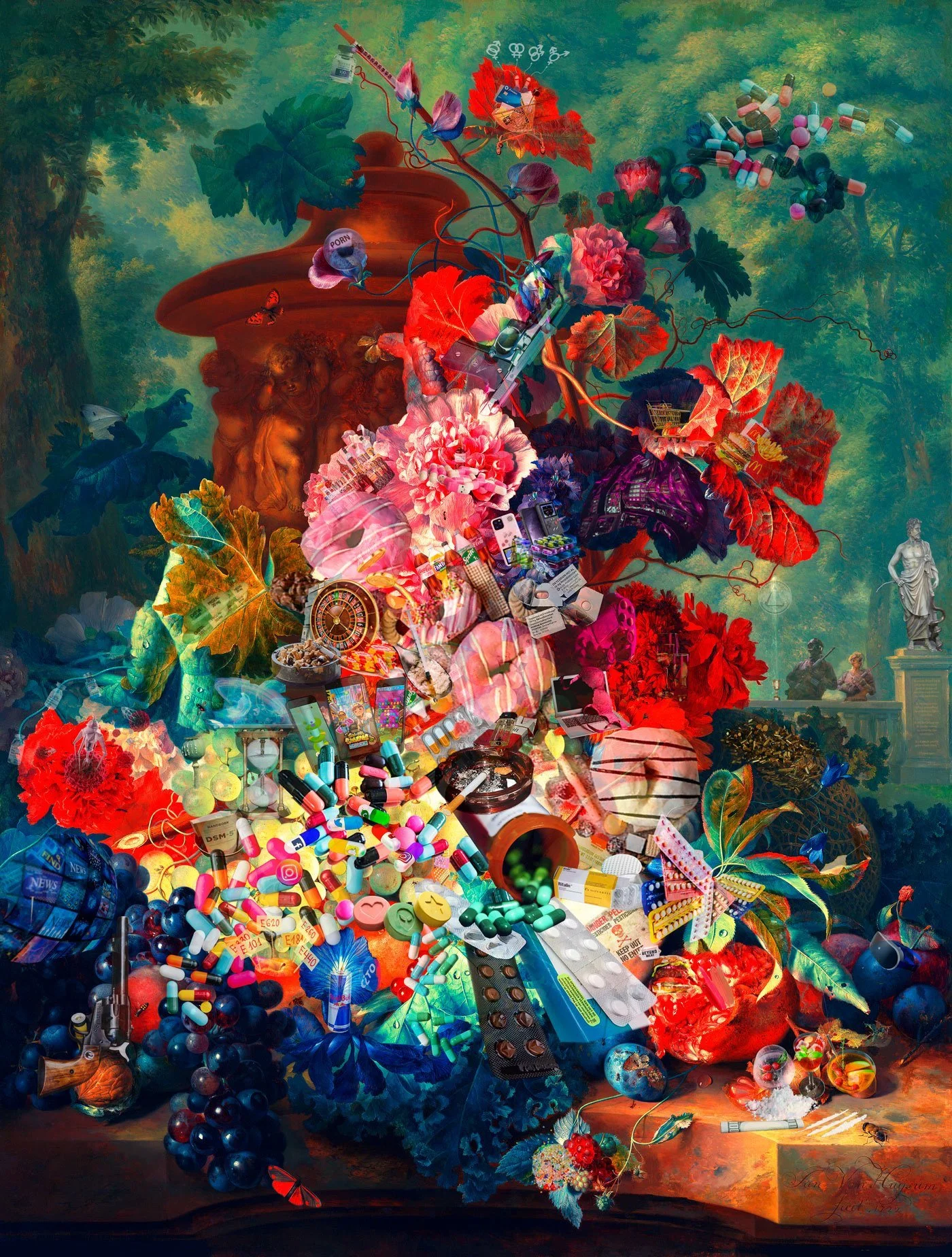
Dit kunstwerk is een spiegel van onze tijd. Waar ooit ons natuurlijke ‘zijn’ -onze ware aard- bloeide, groeit nu een wild boeket van pillen, wapens, fastfood, media en verleidingen. Een modern stilleven-icoon, samengesteld uit alles waarmee we onze pijn verdoven en onze leegte vullen. Het toont de genotszoekende en pijnvermijdende reflexen van onze maatschappij: suiker, drank, drugs, pillen, gokken, cosmetica, schermen, likes, status en macht. Verslaving als ornament.
Trauma als onzichtbare wortel.
Wat mooi lijkt, blijkt giftig. Wat straalt, verstikt. Het is een aanklacht én een uitnodiging: zie hoe ver we verwijderd zijn van onze authenticiteit, maar ook hoe krachtig het kan zijn om deze wond recht in de ogen te kijken.
Geïnspireerd door de visie van Dr. Gabor Maté roept dit werk op tot
her-inneren: het terugkeren naar wie we werkelijk zijn. Niet langer oorlog voeren tegen pijn, maar haar omarmen als poort naar heelheid.
ENG
This artwork is a reflection of our time. Where our natural being—our true essence once flourished, a wild bouquet now blooms of pills, weapons, fast food, media, and temptations. A modern still-life icon, composed of everything we use to numb our pain and fill our emptiness. It reveals the pleasure-seeking and pain avoiding reflexes of our society: sugar, alcohol, drugs, pills, gambling, cosmetics, screens, likes, status, and power. Addiction as ornament. Trauma as invisible root.
What appears beautiful is in fact poisonous. What shines also suffocates. This work is both an indictment and an invitation: to see how far we have strayed from our authenticity, and how powerful it can be to face this wound head-on.
Inspired by the vision of Dr. Gabor Maté, this artwork calls us to re-member: to return to who we truly are. To no longer wage war against pain, but to embrace it as a gateway to wholeness.
The War on Trauma - Genocide on Authenticity
Inspired on the work Dr. Gabor Mate
Based on the work of Jan van Huysum, Fruit & flowers 1722
XS 22 cm x 29 cm
incl. Magnifying glass
Small 70 cm x 92 cm Edition of 10
Medium 90 cm x 119 cm Edition of 10
Large 110 cm x 145 cm Edition of 10
Larger size on request
Art Paper print with white border
Actual print size 38 cm x 50 cm
Het Gat van Fortuin
In het oog van het rad,
in het hart van het zwarte gat,
zijn we nooit gevallen, nooit gestegen.
We zijn de dans zelf, de golf die zich hecht aan geen enkele uitkomst,
het ruisen van het rad zonder rad.
Het Rad van Fortuin blijft draaien — net als de consumptiecycli waarin we gevangen zitten.
Koopdrang als ritueel, bezitsdrang als gewoonte, aankopen als illusie van controle.
Achter het verlangen naar goud, glans en bezit in het centrum van het rad van fortuin schuilt iets anders: de echo van leegte. De leegte die na ieder verlangen naar meer en groter steeds minder en leger blijkt.
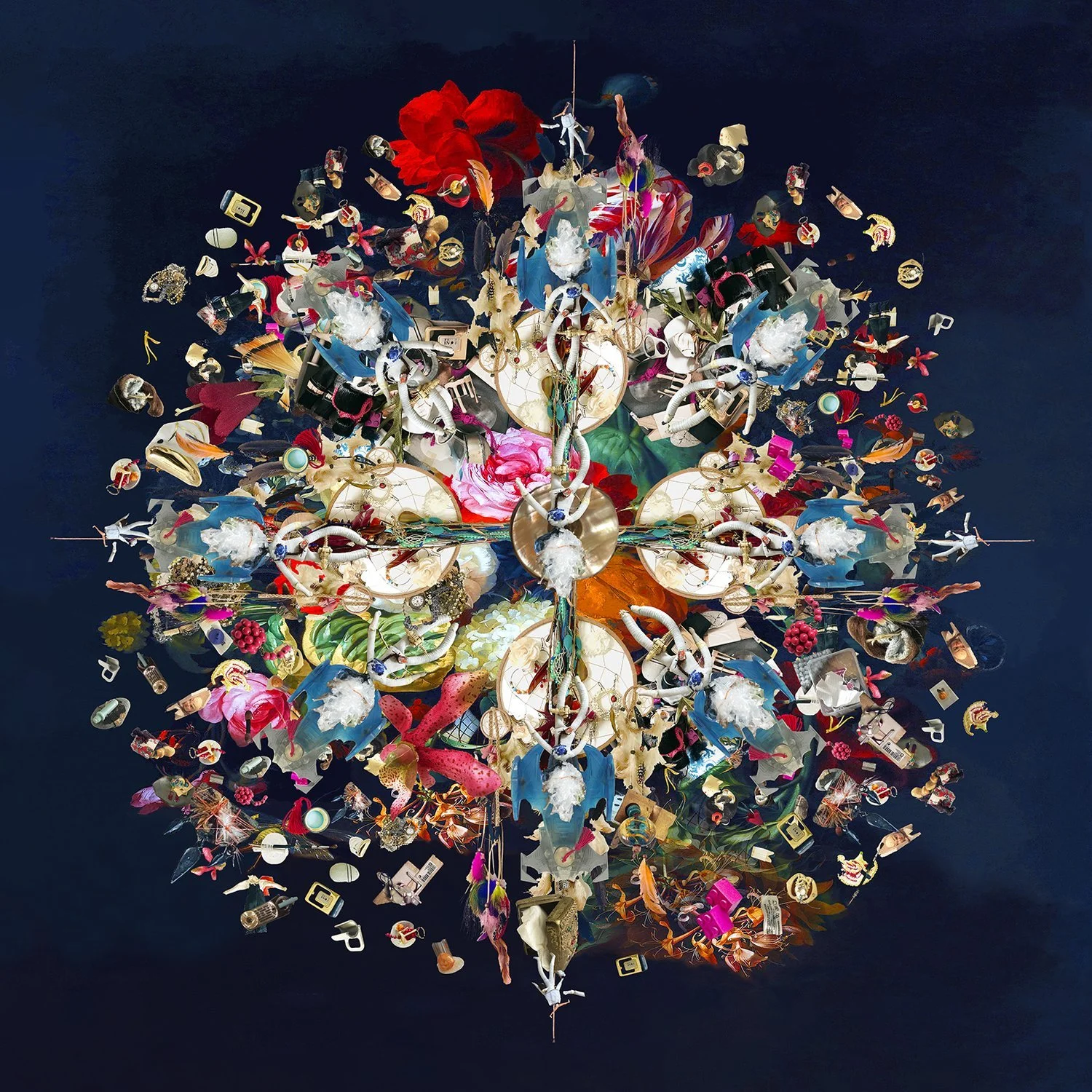
In het gat van fortuin komt het oude rad tot stilstand en opent zich een nieuwe ruimte. Wat ooit draaide — opkomst, val, toeval, verlangen — staat nu stil tegen de achtergrond van een leegte waaruit alles voortkomt en waarin alles verdwijnt. De bron van waaruit de oorsprong en de ontbinding van alle vormen ontstaat. Dit gat is opgebouwd uit alles wat overbleef: resten van fortuin zonder betekenis en waarde, sporen van hunkering en verval, echo’s van het najagen van kortstondig geluk, fragiele herinneringen, en scherven van een wereld die zichzelf voorbij is gelopen.
Wat overblijft is een broze kring van spanning waarin waarde uiteenspat en consumptie haar eigen puin en schaduw tentoonstelt. Restanten samengeperst tot een nieuwe vorm een concentratie van ruwe energie.
Het gat van fortuin nodigt uit om voorbij het zichtbare te kijken voorbij de materie, voorbij de verhalen, voorbij de trekkracht van fortuin en ongeluk. In dat midden, dat absolute midden, bestaat geen boven, geen onder, geen voor of na. Daar heerst de leegte die niet leeg is, de stilte die niet stil is, het zwart dat niet zwart is.
Wat rest, is de stille aanwezigheid van het onnoembare. In deze kern buigt de zwaartekracht. In het hart van het rad raakt materie aan haar oorsprong voorbij tijd en ruimte, betekenis en identiteit. Hier vervalt de lineaire beweging van opkomst en verval; hier lost het rad op in een poort van pure mogelijkheid en potentie. Voorbij de som der delen: in synergie met al wat is.
ENG
In the eye of the wheel,
in the heart of the black hole,
we have never fallen, never risen.
We are the dance itself the wave unattached to outcome, the murmur of a wheel without a wheel.
The Wheel of Fortune keeps spinning just like the cycles of consumption in which we are caught. Desire as ritual. Possession as habit. Purchases as the illusion of control.
Behind the glitter of gold and the hunger for ownership hides something else: the echo of emptiness. Every fulfilled desire leaves us with less, not more. In the hole of fortune, the old wheel halts, and a new space opens. A void from which all arises, and into which all dissolves.
This hole is made of what remains: fragments of fortune stripped of meaning, traces of craving and decay, fragile memories, shards of a world that has run past itself. What remains is a fragile ring of tension:consumption displaying its own rubble and shadow.
The hole of fortune invites us to look beyond the visible, beyond matter, beyond the pull of fortune and misfortune. At its center, there is no above, no below, no before or after. There is only the silence that is not silent, the void that is not void. At the heart of the wheel, matter meets its origin. Here, the linear rhythm of rise and fall dissolves into a portal of pure possibility.
Het Gat van Fortuin
Small 50 cm x 50 cm Edition of 10
Medium 80 cm x 80 cm Edition of 10
Large 110 cm x 110 cm Edition of 10
Materials used
This work is composed of miniature remnants of everyday urban waste: scraps of packaging, plastic, foil, forgotten fragments of the throwaway world. Each was hand-collected and carefully assembled into sculptural compositions, photographed, and digitally merged with a 17th-century flower still life by Rachel Ruysch.
The materials are literal debris yet they carry symbolic weight. What once was considered fortune is now residue. What once glittered is now faded. Through this fusion of classical elegance and contemporary refuse, the work becomes a vessel: where meaning dissolves, and form is reimagined.
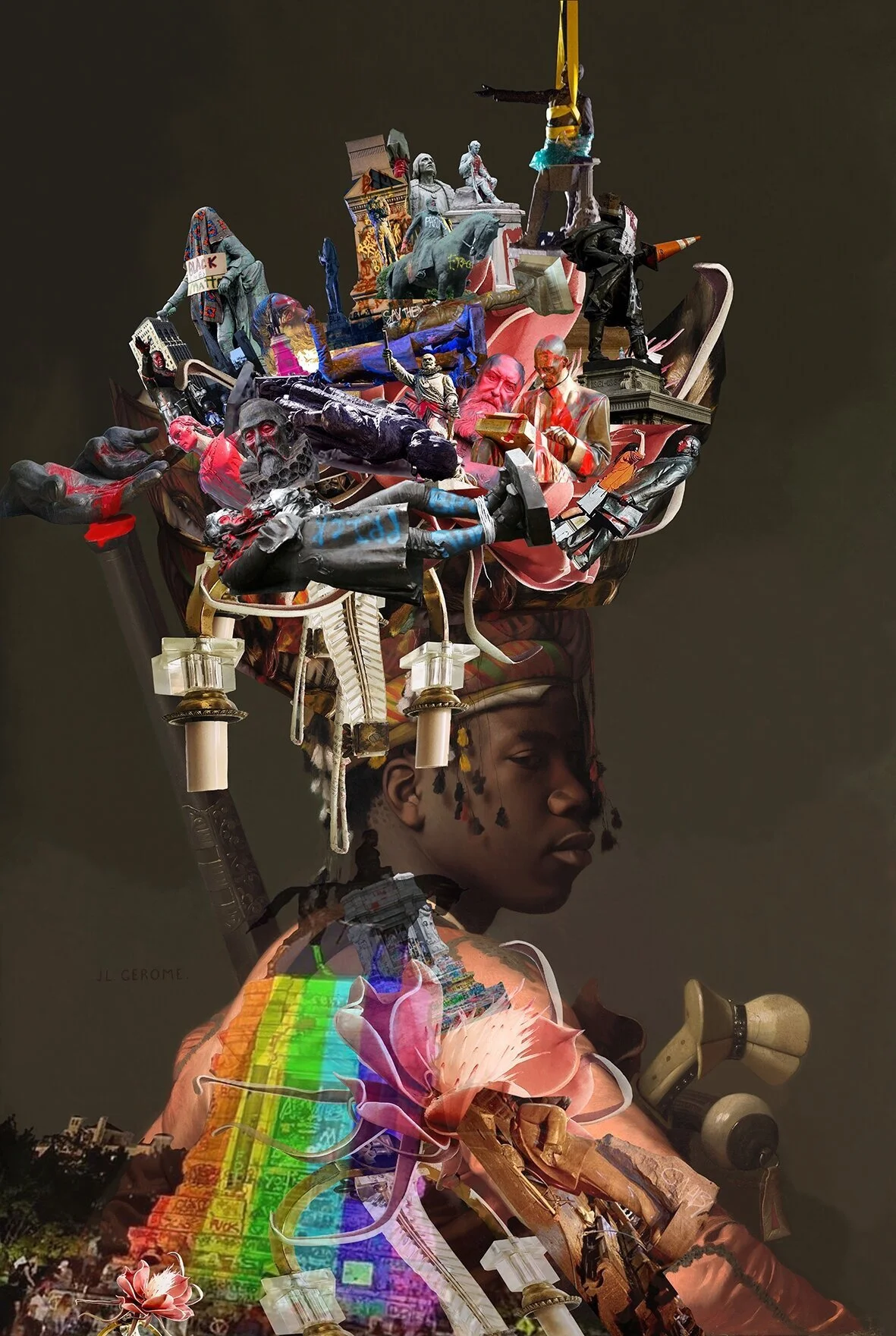
In een sterk gepolariseerde wereld proberen verschillende bevolkingsgroepen de geschiedenis te herschrijven, wat vaak gepaard gaat met veel geweld en strijd. Een ware battle om de geschiedenis en bestaansrecht. Dit is een visioen van een warrior in de frontlinie gewapend met een vredesboodschap. Hij heeft ervaren dat de collectieve geschiedenis niet te overschrijven is door met strijd nieuwe herinneringen te maken en deze over de oude te leggen. Deze warrior heeft ingezien dat vrede sluiten met het verleden door het volledig aan te nemen met al het mooie en minder mooie en te rouwen om hetgeen hij niet heeft gekregen ipv de schuld buiten zichzelf te leggen.
Hij draagt traditioneel Hindoestaanse ceremoniële kleding in de vorm van een bont gekleurde mantel en een uitgesproken hoofddeksel. Hij rouwt en viert het leven tegelijk. De dood en het leven zijn onlosmakelijk verbonden net als licht en schaduw. Hij draagt zijn hoofddeksels met trots, een trots op zijn historische erfgoed waarin ook de monumenten van voormalige vijanden een plek krijgen in zijn bestaan. Je kunt ze namelijk fysiek wel verwijderen, maar de onderliggende betekenis en symboliek blijft bestaan. Hij heeft zijn innerlijk werk gedaan. De kleuren op zijn mantel representeren de uitgelijnde chakra kleuren die aantonen dat hij in balans is en in de flow van het leven meebeweegt.
ENG
In today’s polarized world, groups struggle to rewrite history—often with violence. A true battle for existence.
Here stands a warrior, armed not with weapons but with a message of peace. He has learned that history cannot be overwritten by laying new memories over old wounds. Peace arises only when we accept the past fully—its beauty and its pain and grieve what was missing instead of projecting blame outward.
He wears traditional Hindu ceremonial garments: a radiant cloak and a bold headdress. He mourns and celebrates life simultaneously, embodying the inseparability of death and life, light and shadow. His cloak radiates aligned chakra colors, a sign of balance and flow. Even monuments of former enemies have a place here: you may erase them physically, but their symbolism persists. This warrior has done his inner work. He carries his heritage with pride.
Pride in heritage and history
Pride in Heritage and History
Based on the work: Bashi-Bazouk from Jean-Léon Jérôme - 1868-1869
Small 70 cm x 104 cm Edition of 10
Medium 125 cm x 83 cm Edition of 10
Large 100 cm x 148 cm Edition of 10
Larger size on request
Art Paper print with white border
Actual print size 55 cm x 37 cm
Phoenix rising from the Trashes
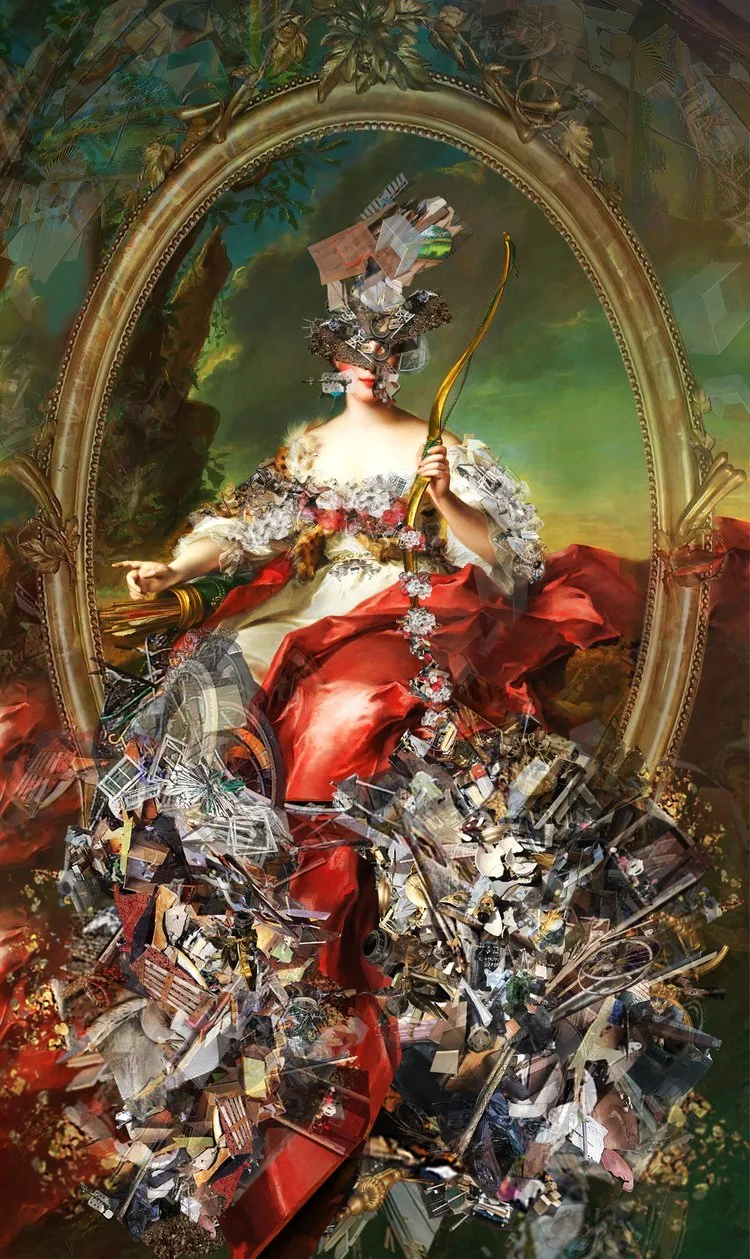
In dit werk herrijst de Phoenix uit afval en resten van het verleden. Ze belichaamt de kracht van transformatie: wat verworpen is, wordt de bouwsteen van een nieuw begin.
De basis van dit schilderij is een klassieke afbeelding van Artemis, godin van de jacht, die in dit werk versmelt met de Phoenix. Haar aanwezigheid symboliseert de verbinding tussen mens en goddelijk, natuur en mythe, licht en schaduw.
De spiegel in het werk is geen begrenzing, maar een poort naar een ruimer bewustzijn. Ze weerspiegelt geen uiterlijk, maar een innerlijke waarheid: dat in onszelf zowel de strijd als de verlossing besloten liggen.
De Phoenix straalt kalmte en kracht uit geworteld in aarde, gericht op het noorden, open naar de eeuwigheid. Zij laat zien dat schoonheid en betekenis ook daar kunnen bloeien waar we het het minst verwachten.
ENG
In this work, the Phoenix rises from waste and remnants of the past. She embodies the power of transformation: what has been discarded becomes the foundation for a new beginning.
At the core of this painting lies a classical image of Artemis, goddess of the hunt, here merging with the Phoenix. Her presence symbolizes the bridge between the human and the divine, between nature and myth, between light and shadow.
The mirror within the work is not a boundary but a gateway to expanded awareness. It does not reflect appearance, but an inner truth: that within ourselves both struggle and redemption reside.
The Phoenix radiates calm and strength, rooted in the earth, oriented to the north, open to eternity. She reveals that beauty and meaning can blossom even in the places we least expect.
Phoenix rising from the Trashes
Inspired on: ‘Madame Bergeret de Frouville as Diana’
by Jean Marc Nattie, 1756
Small 50 cm x 75 cm Edition of 10
Medium 75 cm x 110 cm Edition of 10
Large 95 cm x 160 cm Edition of 10
Larger size on request
Art Paper print with white border
Actual print size 30 cm x 50 cm
NL
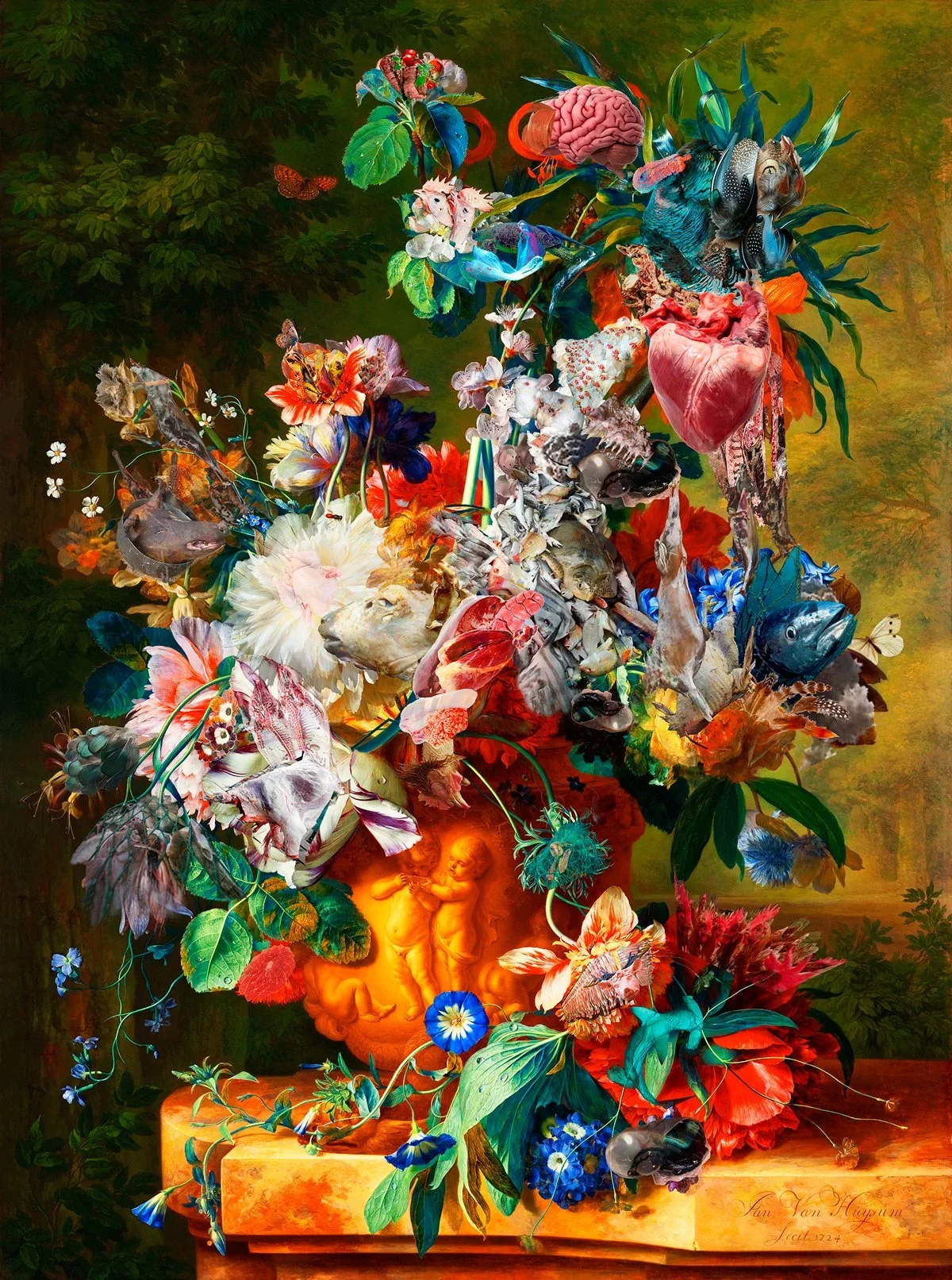
The Convenient Lie lijkt op een klassiek bloemstuk, maar bestaat uit vleesafval, bijvangst, proefdieren, organen en perfect gepresenteerd supermarktvlees. Een kleurrijk boeket van dierlijk leed, samengebracht in een urn symbool voor wat zou moeten eindigen.
Het werk ontstond uit een dubbele confrontatie: de rauwe waarheid over de vleesindustrie én het besef hoe schuld, emotie en klimaatangst kunnen worden ingezet binnen grotere agenda’s. Waar eindigt bewustwording en waar begint beïnvloeding?
In deze spanning tussen wat we eten en wat we niet willen zien, tussen waarheid en narratief stelt het boeket één vraag:
Welke leugens vinden we comfortabel, en welke waarheid durven we wél dragen?
De urn staat voor een toekomst zonder dierenleed, proefdieren, vleesindustrie en manipulatieve klimaatagenda’s. Een wereld die begint bij bewustzijn, niet bij controle.
Food for thought
ENG
The Convenient Lie resembles a classical floral arrangement, yet it is composed of meat scraps, by-catch, lab animals, organs, and perfectly curated supermarket cuts. A vibrant bouquet of animal suffering, gathered in an urn — a symbol of what should already belong to the past.
The work grew out of a double confrontation: the brutal reality of the meat industry, and the realization of how guilt, emotion, and climate fear can be used within larger agendas. Where does awareness end, and where does manipulation begin?
In that tension between what we consume and what we refuse to see, between truth and narrative the bouquet asks one central question:
Which lies feel comfortable, and which truth are we finally willing to face?
The urn stands for a future without animal cruelty, factory farming, lab testing, or coercive climate agendas. A future that begins with consciousness, not control.
Food for thought.
The Convenient Lie
The Convenient Lie
Based on the work Bouquet of Flowers in an Urn by Jan van Huysum ca 1724
Small 70 x 95 cm Edition of 10
Medium 90 x 121 cm Edition of 10
Large. 110 x 148 cm Edition of 10
Larger size on request
Art Paper print with white border
Actual print size 37 cm x 50 cm
Alienated from our true nature
- When the hunter becomes hunted-
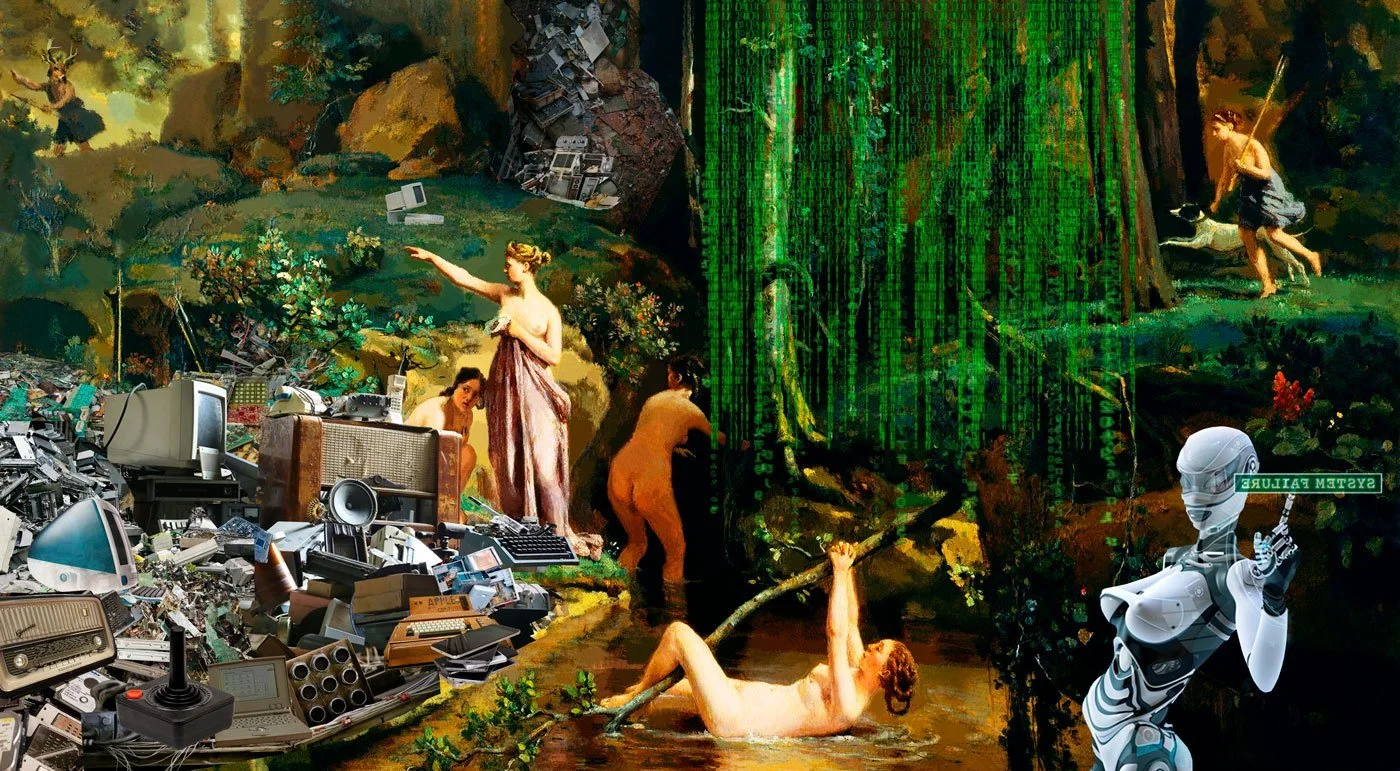
NL In dit kunstwerk botsen twee werelden en vloeien tegelijk samen: de mythologische tijd van goden en natuur, en de digitale tijd van circuits en kunstmatige intelligentie.
De scène grijpt terug op de mythe van Artemis/Diana, godin van de jacht, die door de jager Actaeon bespied werd terwijl zij met haar nimfen baadde. Als straf veranderde zij hem in een hert, waarop hij door zijn eigen honden werd verscheurd: when the hunter becomes hunted. Een eeuwenoude metafoor voor omkering van rollen — dader wordt slachtoffer de jager wordt prooi en het slachtoffer dader, Artemis wordt dader. Een hardnekkige dynamiek zonder bewustzijn.
Tegen deze achtergrond verschijnt een tweede laag: een stroom van digitale codes, algoritmische lianen die als een nieuwe natuur over het beeld groeien. Waar ooit bomen en wortels stonden, verschijnt nu de Matrix. De badende godin wordt niet langer slechts bedreigd door een jager, maar door een soort voorhang van bits & bites die een spanningsveld creëert tussen goddelijke essentie en digitale overschrijving. Een kunstmatige ‘over -the-top’- uitvoering van een vrouwelijke robot drukt op het scherm en fluistert: system failure.
Het werk stelt een indringende vraag: Wat gebeurt er wanneer de mens, in zijn honger naar kennis en controle, steeds verder vervreemdt van zijn ware natuur? Wanneer hij zich overgeeft aan transhumanistische beloftes van verbetering nano-technologie, genetische manipulatie, kunstmatige intelligentie en zichzelf stukje bij beetje verandert in datgene wat hij ooit slechts als instrument gebruikte?
De bergen van elektronisch afval, de vergane glorie van computers en joysticks, vormen de ruïnes van onze digitale mythologie. Terwijl de mythische verhalen ooit waarschuwden voor hoogmoed en overmoed, creëren wij vandaag opnieuw een pantheon maar ditmaal in de taal van nul en één.
Alienated from our true nature is daarmee zowel een waarschuwing als een spiegel. Het werk nodigt uit om te zien dat de belofte van oneindige technologische vooruitgang ook een prijs kent: het risico dat de mens zijn eigen jager wordt, en zijn ziel offert in ruil voor kunstmatige macht.
De vraag die blijft hangen: Willen we werkelijk een levende machine worden, of herinneren we ons dat wij zelf altijd al een levend mysterie waren?
Two worlds collide and intertwine: the mythic realm of gods and nature, and the digital age of circuits and AI.
The scene recalls the myth of Artemis/Diana, goddess of the hunt, spied upon by Actaeon. In rage, she transformed him into a stag, hunted down by his own hounds: when the hunter becomes the hunted. A tale of roles reversed, echoing through time.
Against this mythic backdrop, another layer emerges: streams of code, algorithmic vines creeping like a new forest. Where trees once stood, the Matrix grows. The bathing nymph faces not only Actaeon, but also a curtain of bits and bytes pressing in. A robotic simulacrum whispers: system failure.
The artwork asks: What happens when humanity, in its hunger for control, drifts further from its essence? When it embraces transhumanist promises: nanotech, genetic manipulation, AI until it becomes the very machine it once built as tool?
Piles of e-waste , broken consoles, and fading circuits form the ruins of our digital mythology. Like the ancient myths warning against hubris, we now create a pantheon of our own in binary.
Alienated from Our True Nature is both warning and mirror. It shows that the pursuit of technological transcendence comes with a price: the risk of becoming our own predator, sacrificing soul for artificial power.
The question that remains: Do we really want to become a living machine, or do we remember that we ourselves have always been a cosmic living mystery?
Alienated from our true nature
- When the hunter becomes hunted -
Based on the work of Camille Corot, 1796–1875 Paris, Title: Diana and Actaeon (Diana Surprised in Her Bath)
Small 110 cm x 60 cm Edition of 10
Medium 130 cm x 71 cm Edition of 10
Large 150 cm x 82 cm Edition of 10
Larger size on request
Art Paper print with white border
Actual print size 55 cm x 30 cm